Egg Binding in Birds, Part 2: "How to Treat Egg Binding?
2004 Views |
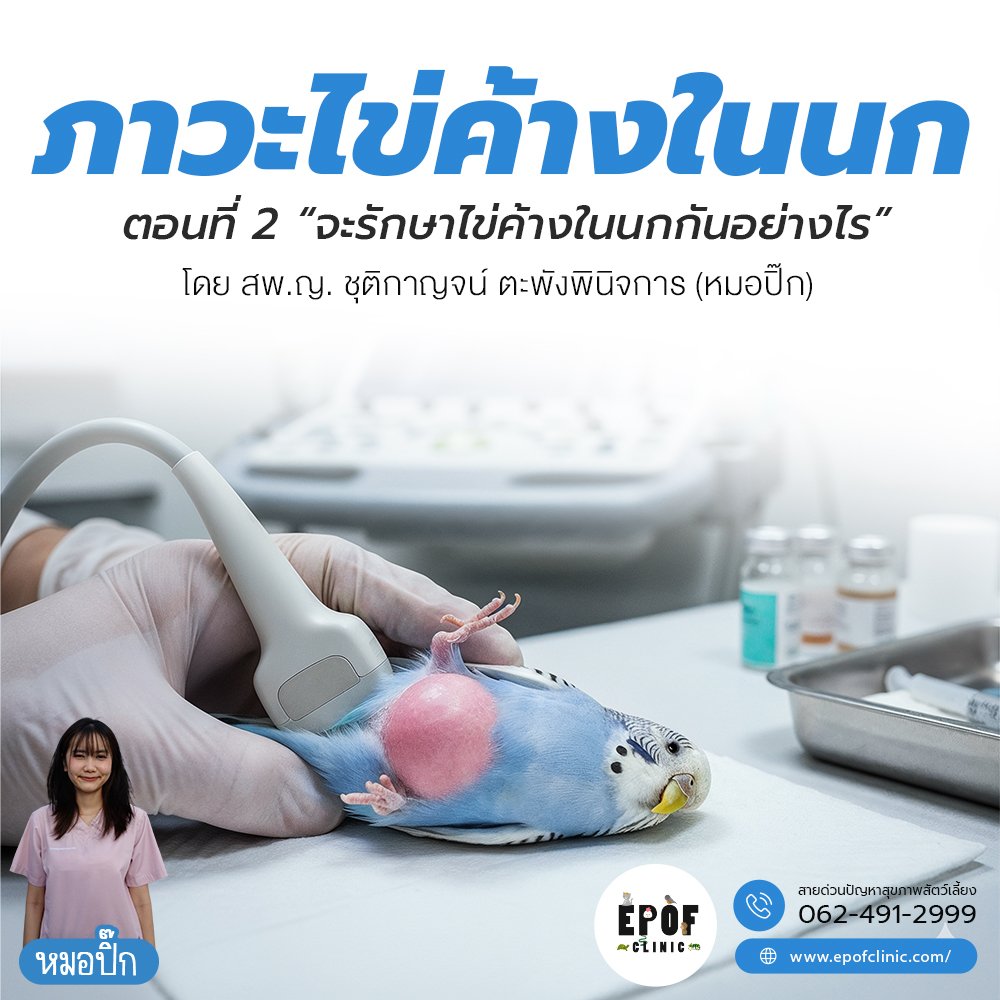
Egg Binding in Birds, Part 2: "How to Treat Egg Binding?" By Veterinarian Chutikarn Tapangpinijkan (Dr. Pik), Kwankham Animal Hospital
For the treatment guidelines for birds diagnosed with egg binding, the first step is stabilization. If the bird is experiencing difficulty breathing, displaying heavy abdominal breathing, or open-mouth breathing, its condition must be stabilized first—often by placing the bird in an oxygen chamber. Once the bird is stable, further treatment can proceed.
Treatments for egg binding in birds can be divided into two main categories:
1. Medical Treatment
This involves administering medication as initial supportive therapy. It is usually performed when a diagnosis confirms that the egg is normal in shape and its size allows it to be passed through the cloaca naturally. Treatments include:
Fluid therapy: Administered subcutaneously (under the skin) or intravenously.
Analgesics (Pain relief): The most commonly used painkiller in birds is butorphanol, administered via intramuscular injection.
Calcium supplementation: Given to help the bird gain enough strength to pass the egg on its own. Calcium gluconate is injected subcutaneously, typically in a low dose given continuously over several days rather than as a single dose.
Prostaglandin E2 gel: This may be considered for topical application directly on the cloaca to stimulate uterine contractions, which can help expel the egg within 15 minutes.
2. Surgical Treatment
Surgical methods require anesthesia. There are several techniques, and the choice depends on the specific problem found in each individual bird:
Manual delivery: This is performed when medical treatment has been administered but the bird still hasn't passed the egg after 24 hours. This procedure carries a risk of cloacal prolapse or oviduct prolapse.
Episiotomy: Often used in small birds where the egg is stuck in the distal (lower) oviduct but is too large for the bird to pass. This method involves making an incision to widen the opening, which must be sutured closed afterward.
Ovocentesis (Egg aspiration): This can be done in two ways:
Transcloacal aspiration: Usually performed when the eggshell is thick and the egg is too large to be expelled naturally. After aspirating the fluid from inside the egg, the shell fragments must be gently and completely removed to prevent internal wounds in the reproductive tract and secondary infections.
Transcoelomic aspiration: Often done when the eggshell is soft, allowing it to be expelled naturally once the fluid is drained. However, this method carries a risk of coelomitis (inflammation of the abdominal cavity) due to potential leakage of the egg's contents.
Ventral coeliotomy: A surgical incision through the abdomen to perform a hysterotomy (opening the uterus to remove the egg) or a hysterectomy (removal of the uterus/spaying). This is the appropriate method when the egg is firmly adhered to the oviduct, the shell is abnormal or missing, the uterus has ruptured, or if it is an ectopic pregnancy (egg in the wrong location).
According to studies, egg binding is most commonly found in small bird species, particularly Cockatiels and Budgerigars. The treatment success rate is quite high, and most birds will improve and successfully lay the egg with just medical treatment. Therefore, if your pet bird shows abnormal symptoms suggesting egg binding as mentioned above, you should rush them to the vet immediately.
References:
Vavlas, A., Galusha, H., Mayer, J., Speer, B., & Di Girolamo, N. (2025). Resolution of egg binding is possible in most client-owned parrots when multiple treatment strategies are considered. Journal of the American Veterinary Medical Association, 263(5), 628–634. https://doi.org/10.2460/javma.24.11.0749
Chitty, J., & Monks, D. (Eds.). (2018). BSAVA manual of avian practice: A foundation manual. British Small Animal Veterinary Association.
Samour, J. (Ed.). (2016). Avian medicine (3rd ed.). Elsevier.
König, H. E., Korbel, R., & Liebich, H.-G. (2016). Anatomy of birds (C. Klupiec, Trans.). 5m Publishing. (Original work published 2009)
Reddy, B. S., & Sivajothi, S. (2018). Egg binding in Budgerigar (Melopsittacus undulatus) – an emergency condition. International Journal of Avian & Wildlife Biology, 3(5), 352–353. https://doi.org/10.15406/ijawb.2018.03.00137


