Egg Binding in Birds, Part 1: "How to Tell if Your Bird is Egg-Bound"
2026 Views |
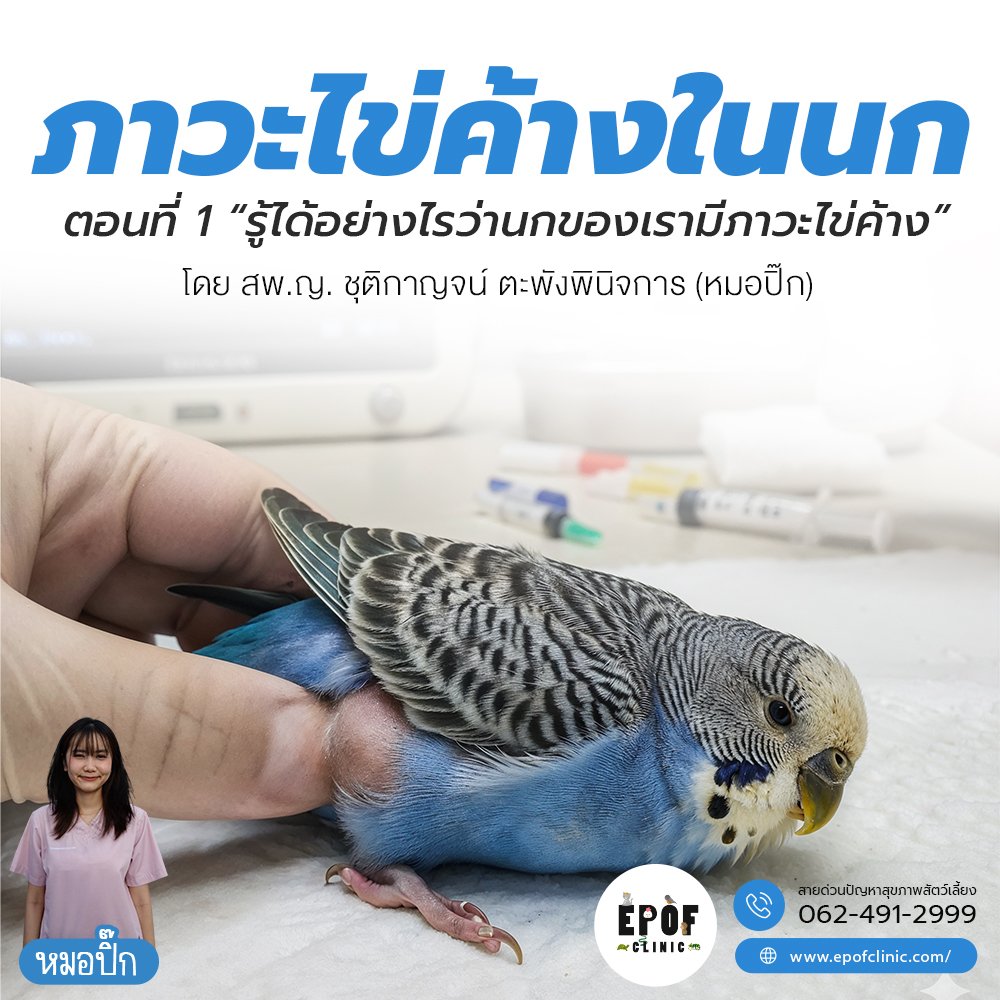
Egg Binding in Birds, Part 1: "How to Tell if Your Bird is Egg-Bound"
By Dr. Chutikarn Tapangpinitkarn, DVM (Dr. Pik), Kwankham Animal Hospital
Egg retention (Egg binding) is an emergency condition where an egg fails to pass through the oviduct normally. It requires immediate attention because the retained egg can compress internal abdominal organs, air sacs, lungs, and blood vessels. If your bird shows abnormal symptoms suggesting egg binding, you should rush them to a veterinarian for an immediate diagnosis and treatment.
Causes of Egg Binding
The causes vary depending on the bird species and are often a combination of multiple factors, including:
Malnutrition and low calcium levels (hypocalcemia).
Smooth muscle dysfunction in the oviduct or uterus.
Infection, trauma, or tearing of the oviduct.
Obstruction in the oviduct (e.g., from tumors).
Eggs that are excessively large.
Egg abnormalities (e.g., shells that are too thin or completely absent).
Stress from an inappropriate environment (e.g., temperatures that are too hot or too cold).
Obesity.
Excessive or overly frequent egg-laying.
Other underlying reproductive system abnormalities.
The Normal Egg Formation Process
Normally, a female bird's reproductive system creates an egg through the following steps. It begins at the ovary, where ovulation occurs and the yolk is formed. The yolk then travels into the oviduct, which is divided into five distinct sections:
Infundibulum: Receives the yolk from the ovary and serves as the site of fertilization.
Magnum: Produces the albumen (egg white).
Isthmus: Creates the shell membranes.
Uterus: Responsible for forming the hard eggshell.
Vagina: The final section that expels the egg out of the body.
How to Spot the Symptoms
Owners can observe their birds at home for signs of distress. Common symptoms of egg binding include:
In Small Bird Species: Usually present with sudden lethargy, difficulty breathing, fluffed feathers, and squinting or closed eyes. The abdomen may look and feel abnormally enlarged. In some birds, the egg can actually be felt through the abdomen.
In Large Bird Species: Often seen sitting with their abdomen pressed flat against the floor. Some may stand with their legs unusually wide apart, show signs of weakness, strain frequently to defecate, pass abnormally large droppings, or have feces stuck around the vent. This is often accompanied by difficulty breathing.
Veterinary Diagnosis
If your bird shows any of these symptoms, take them to a veterinarian immediately. A vet will typically use the following steps to confirm egg binding:
History Taking: Gathering care and behavioral information from the owner.
Physical Examination: A thorough check of the bird's body.
Laboratory and Diagnostic Imaging:
X-ray (Radiography): To evaluate the shape, size, and position of the egg, as well as to assess bone density and overall physical condition.
Ultrasound: Used if x-rays show abdominal abnormalities but no hard eggshell (e.g., shell-less eggs), or to evaluate the internal structure of the reproductive tract.
Blood Tests: Often used to check for low blood calcium levels (hypocalcemia).
References:
Vavlas, A., Galusha, H., Mayer, J., Speer, B., & Di Girolamo, N. (2025). Resolution of egg binding is possible in most client-owned parrots when multiple treatment strategies are considered. Journal of the American Veterinary Medical Association, 263(5), 628–634. https://doi.org/10.2460/javma.24.11.0749
Chitty, J., & Monks, D. (Eds.). (2018). BSAVA manual of avian practice: A foundation manual. British Small Animal Veterinary Association.
Samour, J. (Ed.). (2016). Avian medicine (3rd ed.). Elsevier.
König, H. E., Korbel, R., & Liebich, H.-G. (2016). Anatomy of birds (C. Klupiec, Trans.). 5m Publishing. (Original work published 2009)
Reddy, B. S., & Sivajothi, S. (2018). Egg binding in Budgerigar (Melopsittacus undulatus) – an emergency condition. International Journal of Avian & Wildlife Biology, 3(5), 352–353. https://doi.org/10.15406/ijawb.2018.03.00137


