Black Mold Stains "Sooty Mold" on Hay? Is it Dangerous to Herbivores?
7532 Views |
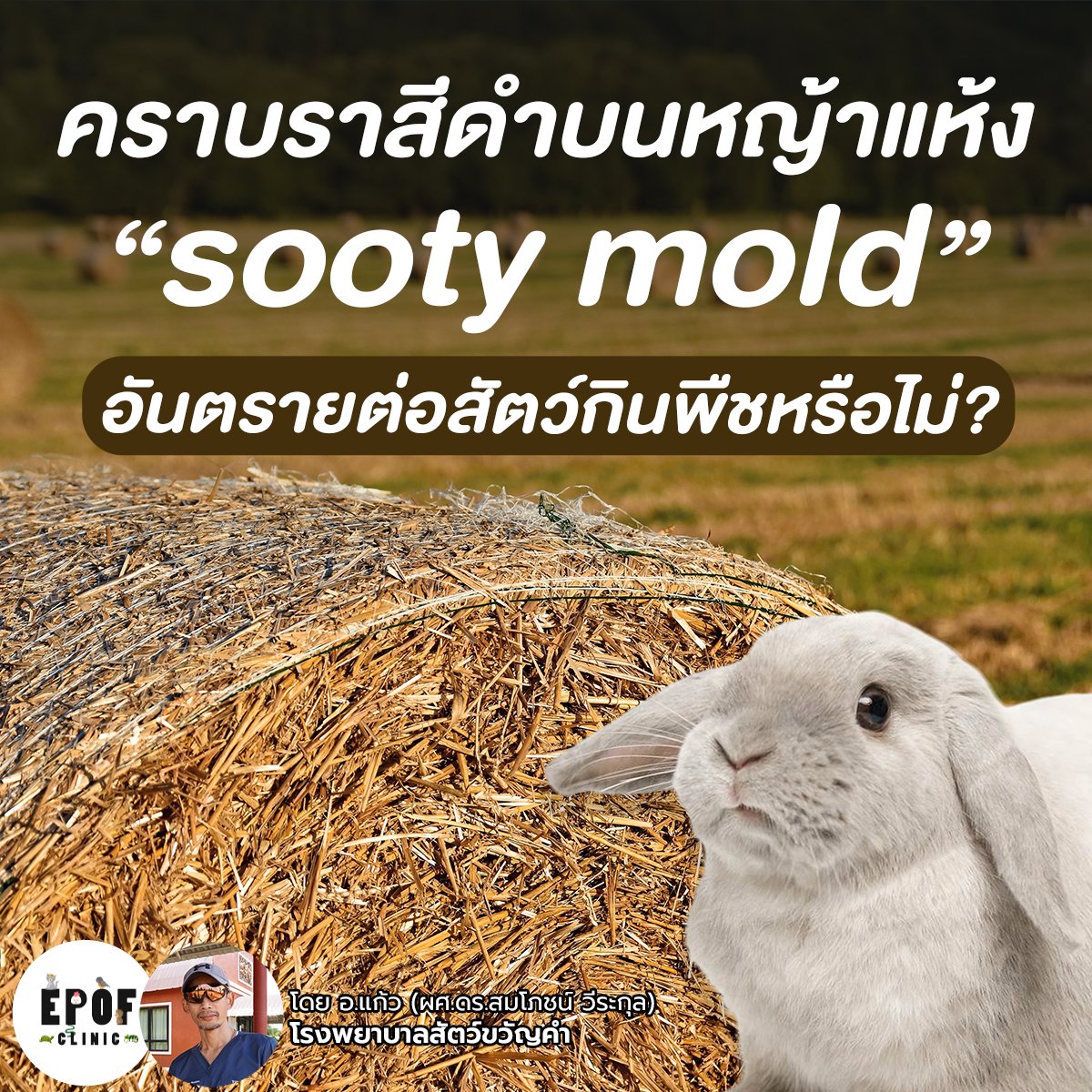
Black Mold Stains "Sooty Mold" on Hay? Is it Dangerous to Herbivores?
By Ajarn Kaew (Assoc. Prof. Dr. Sompote Weerakul)
Many owners of rabbits, chinchillas, capybaras, and guinea pigs often become anxious and reach out with questions when they find black stains or soot-like marks on hay stalks. What many don't realize is that certain types of black mold, commonly referred to as "sooty mold," are naturally found on various grasses.
What is Sooty Mold? The spores of this mold are naturally airborne and can be found across a wide variety of plants and fruits—including mangoes, longans, durians, grasses, and sugarcane—as well as on wooden furniture, which is highly susceptible to this fungal infection.
Genus: This fungus belongs to the Capnodium sp. genus, which includes several species.
Effects on Plants: The black mold stains adhere to plant parts, affecting their growth, reproduction, and fruiting, and making the fruit look unappetizing. While it usually spreads only on the surface, some species can consume wood, causing more severe damage to plants and wooden furniture.
How and Why It Grows The fungus thrives on "honeydew"—the sugary excrement left behind by insects like aphids and whiteflies—as well as on the natural carbohydrates found within the plants themselves.
Why Oat Hay is Vulnerable: Oat hay is much more prone to these mold stains than Timothy or other grasses because its plant cells contain higher amounts of starch and carbohydrates. Even when the hay is dried to a low moisture content of about 7-8%, the starch in oat hay acts as a food source for spore growth.
Spread and Environment: The mold usually occurs only on isolated stalks and does not spread wildly. Growth is promoted by hot and humid weather, typically at temperatures between 25-35°C and humidity levels of 40-80%. Harvesting or storing hay in these conditions increases the risk of contamination.
Baled vs. Loose Hay: Baled hay carries a higher risk because it has poorer ventilation, causing it to retain a higher moisture level (around 18-22%). While still relatively low, this makes it riskier than loose, unbaled hay.
Storage and Prevention Great care must be taken during storage. You must prevent the hay from getting wet and ensure excellent ventilation.
If using oat hay, be mindful of its susceptibility to contamination. It is best to use fresh packaging and hand-sort the hay before feeding.
Additionally, since black mold frequently grows on fruits and fruit peels, hay should never be stored near them.
Is it Dangerous to Pets? Capnodium is not considered a pathogen that causes infections in humans or animals. On the contrary, some extracts from it are being studied for their potential as novel antibiotics, such as methiosetin (Herath et al., 2012: Journal of Natural Products 75(3):420-4).
Comparison with Dangerous Molds To put things in perspective, the livestock industry often deals with a much more dangerous fungal group: Aspergillus sp., which produces deadly aflatoxins. Aspergillus typically develops in wet hay, hot weather, and large bales or piles. However, it is rarely found in properly dried hay, unless subsequent storage conditions are highly damp and unventilated (this topic is covered in a separate article).


