Is Alfalfa Truly Dangerous? How to Feed Alfalfa to Adult Rabbits
3769 Views |
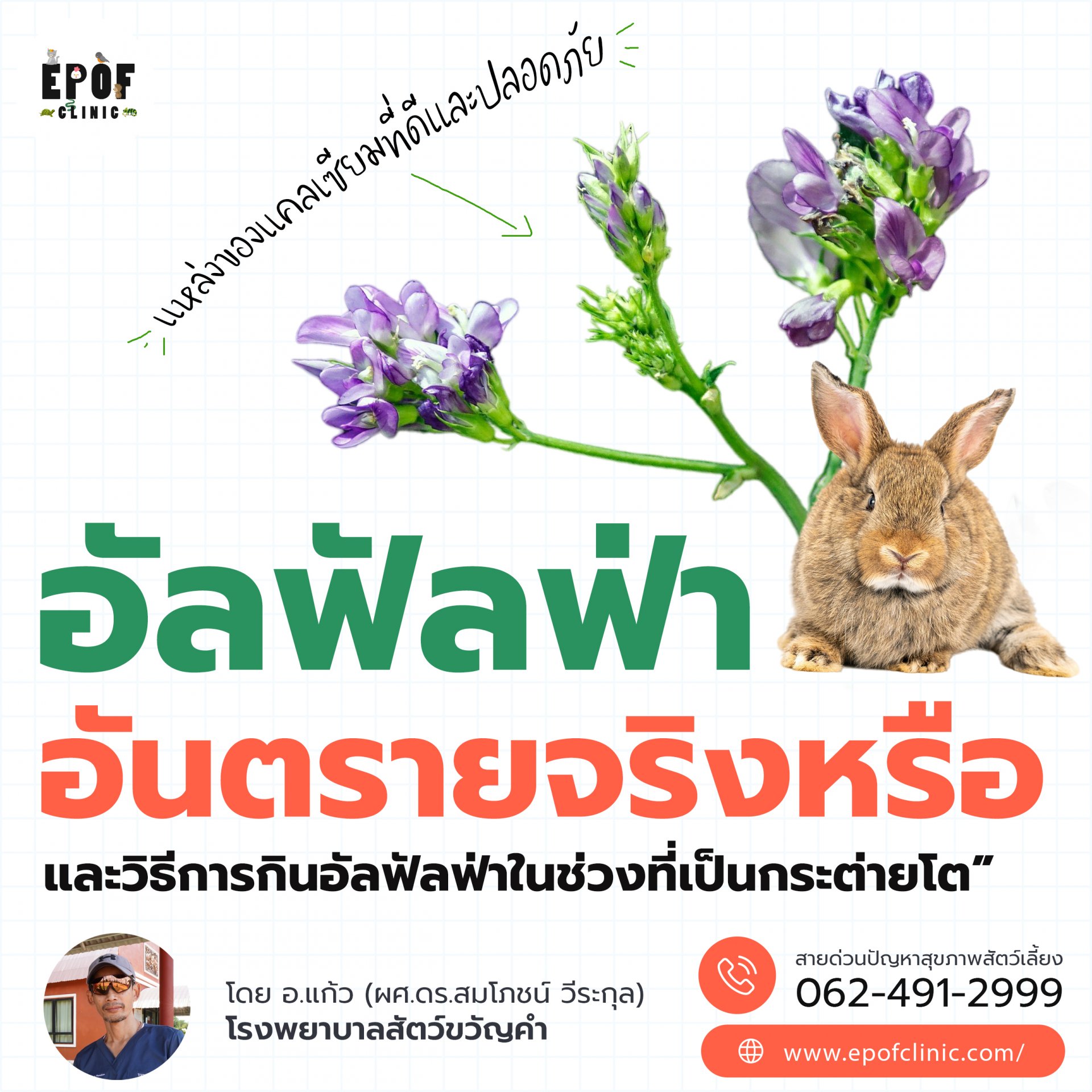
Is Alfalfa Truly Dangerous? How to Feed Alfalfa to Adult Rabbits
By Assist. Prof. Sompoth Weerakul, DVM, PhD
Pet rabbits often suffer from low bone density, structural weakness, and easy fractures. This can lead to muscle weakness, low growth rates, and dental issues such as weak teeth and poor enamel development due to dietary calcium deficiency. While owners often want to provide calcium supplements, many are afraid to use Alfalfa or other calcium sources for fear of causing bladder stones or cloudy urine (sludge). This fear is often reinforced by warnings from veterinarians and social media, which contain both correct and incorrect information. So, what should we do?
The Role of Calcium and Alfalfa
Alfalfa is a good and safe source of calcium. While high-fiber pellets are acceptable, they must be fed in limited quantities. Furthermore, many pellets are formulated with low calcium levels based on NRC standards, which may be insufficient for modern needs.
Most grass hays contain 0.28% – 0.75% calcium, whereas Alfalfa contains significantly more at 1% – 4.39%. Most commercial pellets do not exceed 1% calcium. An adult rabbit (non-pregnant/non-lactating) requires approximately 500 mg of calcium per 2.5 kg of body weight (200 mg/kg) as a Recommended Dietary Allowance (RDA). This requirement increases 2–5 times during breeding, pregnancy, or lactation. Some reports suggest that for maintenance, a diet should contain 0.22 g (220 mg) of calcium per 100 g of food. This means a 1 kg rabbit would need to consume 100 g of pellets daily. To improve bone density and growth rates, the calcium level should be increased to 350–400 mg per 100 g of food.
The Pellet Dilemma
Standard recommendations for high-fiber pellets suggest only 20–40 g (approx. 2–4 tablespoons) per day, averaging 25 g per 1 kg of body weight (RSPCA). At this rate, a rabbit receives only about 0.25 g (250 mg) of calcium, which is sufficient for a 1 kg rabbit. However, many pellets are formulated with very low calcium levels (around 0.2%, mimicking grass). If fed at the recommended amount, the rabbit would lack 4/5 of its required calcium.
To compensate, one must choose "hay-replacement" pellets that can be fed in larger quantities—80 g or more per day for a 1 kg rabbit (alongside hay, which also contains calcium). Some specialized pellets are designed to replace hay with high fiber and an "ideal diet" calcium level of 0.6% – 1%, though concerns regarding dental wear still exist.
Since hay often lacks sufficient calcium and pellets are limited by quantity, Alfalfa remains the primary choice for supplementation. But how and when should it be used or avoided?
Daily vs. Periodic Supplementation
In the wild, rabbits select a variety of plants, making calcium deficiency rare. Exposure to Vitamin D also helps balance calcium levels. (Refer to my previous article on calcium for more details).
While many veterinary documents and practitioners advise stopping Alfalfa once a rabbit reaches adulthood, it is actually beneficial—and often necessary—during pregnancy, lactation, growth, or for individuals with dental developmental issues or X-ray-confirmed low bone density (osteopenic vertebral compression).
Some reports from the US suggest a ratio of 32% Alfalfa to 15% Grass Hay. I believe this lacks sufficient justification unless used within a complete feed formulation. If Alfalfa and hay exceed 50% of a pellet’s composition, intake must be restricted to prevent excessive starch consumption.
Practical Guidelines for Alfalfa Supplementation:
Direct Supplementation: To provide roughly 0.2 g (200 mg) of calcium for a 1 kg rabbit, feed 20 g of Alfalfa daily (or 2 tablespoons of Alfalfa pellets / 1–2 pieces of Alfalfa snacks).
For a 2.5 kg Rabbit: Aim for 500–600 mg of calcium, increasing this 2–5 times during breeding or pregnancy, while maintaining grass hay as the primary diet.
Periodic Treats: Offer larger amounts every 2–3 days or once a week as a treat. This provides protein, calcium, and mental enrichment.
Observations and Risks: Sludge and Stones
Veterinarians and owners must work together. While we may not be able to fully reverse osteopenic vertebral compression, we can strengthen the bone and prevent further degradation. Bone health should be monitored via X-ray.
While blood calcium tests are an option (typical range is 2.2–3.0 mmol/l, though some rabbits reach 3.25–3.75 mmol/l—much higher than other animals at 1.25–1.6 mmol/l), they aren't always the best diagnostic tool.
If cloudy urine (bladder sludge) occurs, evaluate daily water intake first. Sludge is more often linked to dehydration than excess calcium. A rabbit should drink 50–150 cc per kg of body weight daily to prevent stones. If sludge persists despite adequate hydration, stop Alfalfa until the urine clears, then gradually reintroduce it to find a healthy balance. Avoiding calcium entirely is not an option.
The "Scapegoat" Effect
Bladder stones and sludge, which lead to cystitis and kidney damage, typically appear in rabbits aged 3–5 years. Causes include:
Inadequate water intake
Lack of exercise/activity
Obesity
Kidney disease
High-calcium diets
Alfalfa is often blamed as the sole culprit, but the facts are more nuanced. The three most common stones in rabbits are Calcium Carbonate (monohydrate and anhydrous) and Ammonium Magnesium Phosphate. Interestingly, the calcium in Alfalfa is 20% – 33% Calcium Oxalate, which is a less common stone type in rabbits. Some reports (Johnson, 2009) even suggest that rabbits do not metabolize the calcium oxalate found in plants/Alfalfa, meaning it may not contribute to urinary sediment or stones. In contrast, Calcium Carbonate—the primary component of stones and sludge—is mostly found in commercial pellets, yet pellets are rarely blamed because they are fed in smaller amounts.
Conclusion
Alfalfa is a safe, natural source of calcium when supplemented in appropriate amounts. We should be more concerned with other risk factors—like dehydration and lack of activity—than with Alfalfa itself.


