Characteristics of Milk in Rabbits, Rodents, Sugar Gliders, and Mammalsยนมขนาดเล็ก - และอาหารทดแทนนมชนิดใดบ้าง?
3300 Views |
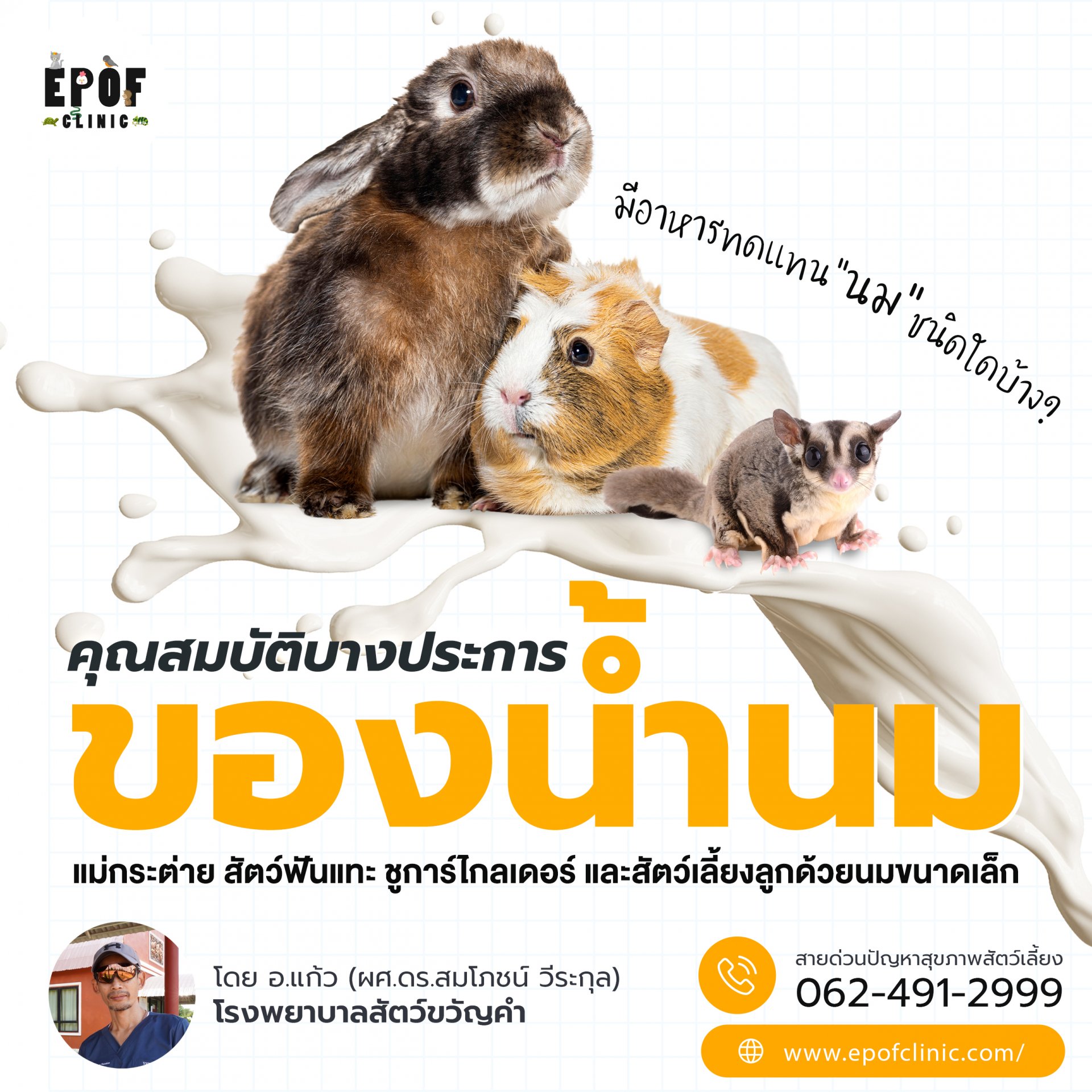
Characteristics of Milk in Rabbits, Rodents, Sugar Gliders, and Mammals
As previously discussed in several articles, the natural milk of these specific animals is characterized by high protein and high fat content, while being low in carbohydrates. Specifically, the lactose levels are significantly lower than those found in cow's milk. There are various milk replacers available; some use milk powder as a base, while others are formulated entirely with alternative raw materials to mimic the properties of mother's milk without relying on dairy from other species (such as cows or goats).
Milk Production in Rabbits
A doe (mother rabbit) begins to increase milk production from day 2 post-partum, reaching peak production between days 2 and 14. During this peak, some breeds can produce up to 300 grams per day. Over a 28-day lactation period, a single doe may produce up to 7 kilograms of milk.
The average nutritional values for dry matter, protein, fat, and lactose during the first three weeks are 29.8%, 12.3%, 12.9%, and 1.7%, respectively. The notably high fat content is a trait shared with rodents and other small mammals. For instance:
Rats: Milk fat levels reach 12.5%–15.8%, though their protein levels are slightly lower than rabbits at 8.9%–9.2%.
Sugar Gliders: Studies show protein levels between 16%–19% and fat levels between 3%–15%. Research indicates that diets with higher protein and fat result in better growth rates and weight gain (Dierenfeld & Whitehouse-Tedd, 2017).
Fatty Acid Composition
In rabbits, the production of protein, casein, saturated fats, and lactose is highest during the first 9 days. A unique feature of rabbit milk is that its high fat content consists of various free fatty acids (Ludwiczak et al., 2023).
Common fatty acids found include $C12:0, 14:0, 15:0, 16:0, 18:0, 18:1$ (trans-6/8, trans-9, and cis-9), $18:2n-6, 18:3n-3, 20:1$ cis-9, $20:2n-6,$ and $22:0$ (Betancourt López, et al., 2019). Some reports highlight exceptionally high levels of caprylic acid, capric acid, and lauric acid (Maertens et al., 2006), which differs from cow's milk where $C4:0$ and $C12:0$ are more predominant (Auldist et al., 1998).
The lipid profile of rabbit milk is approximately:
SFA (Saturated Fatty Acids): 70.4%
MUFA (Monounsaturated Fatty Acids): 12.8%
PUFA (Polyunsaturated Fatty Acids): 15.6%
This indicates that rabbit milk has higher MUFAs and PUFAs than cow's milk, while SFAs remain similar. Compared to swine, rabbits have higher SFAs but lower MUFAs (Mollica et al., 2021). Research shows that when milk fat decreases, digestibility also drops, which is directly linked to lower growth and survival rates.
The Importance of Milk Replacers
The survival of kits (baby rabbits) depends on the volume and chemical composition of the mother's milk. Therefore, providing a milk replacer that closely mimics these properties is vital in cases of early weaning, maternal rejection, or orphaning.
While we previously discussed HPW or Zoological Matrix, another notable option is the Specialty Milk Replacer by Exotic Nutrition. This brand specializes in high-protein diets, such as HPW and Marsupial Milk Replacers (based on Wombaroo formulas). These "specialty" products are distinguished from standard puppy, kitten, cow, or goat milk replacers by their specific nutrient density.
Key features of Specialty Milk Replacers:
Protein and Fat: Minimum 24%, which is significantly high.
Carbohydrates: Low starch and sugar content.
Fortification: Balanced levels of Vitamins A, D, and E.
Digestibility: Uses highly digestible proteins and fats, often incorporating Medium-Chain Triglycerides (MCTs).
Even after dilution for feeding, these formulas are designed to maintain nutrient levels higher than cow or goat milk to meet the physiological demands of the young animal.
Conclusion
The fundamental principle is ensuring sufficient energy and a nutrient profile that meets or exceeds the animal's minimum requirements to prevent malnutrition. In practice, caregivers must monitor intake, growth rates, and consistency.
These high-protein, high-fat formulas serve a dual purpose: they are not just for orphans, but also act as a nutritional supplement to prevent deficiencies during post-weaning growth and as a recovery aid for sick rabbits, rodents, sugar gliders, and other marsupials.


