Getting to Know the Bushbaby: A Deep Dive into its Ancestry
3505 Views |
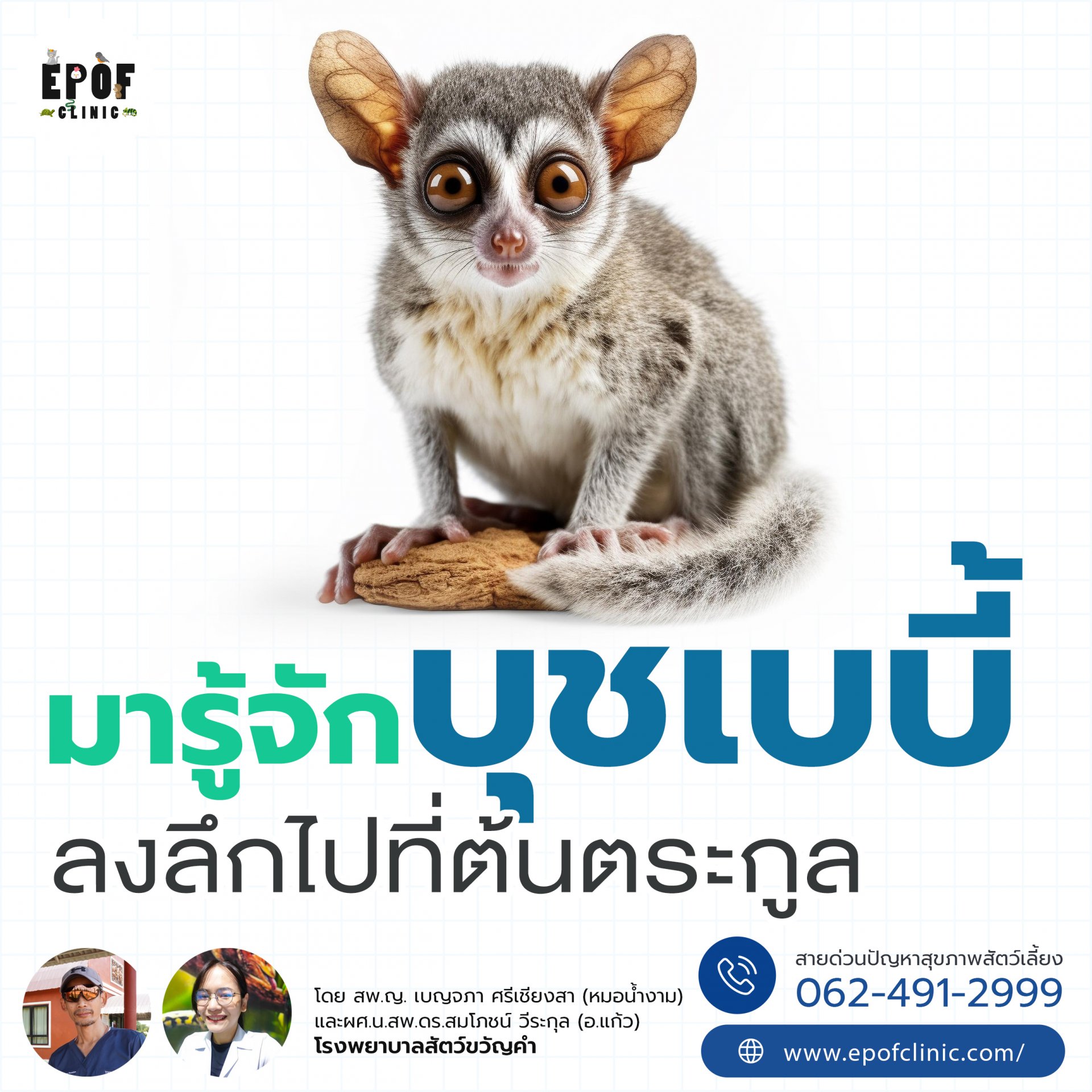
Getting to Know the Bushbaby: A Deep Dive into its Ancestry
While many have discussed how to keep them as pets, let’s explore their lineage. Understanding their ancestry helps us better grasp their biology and natural needs. Taxonomically, bushbabies belong to the group known as galagos (sometimes simply called galagos) within the genus Galago, family Galagidae, and the order Primates. There are many species within this family; the one most commonly kept as a pet in Thailand is G. moholi. Appearance-wise, they closely resemble the Slow Loris because they share the same superfamily: Lorisoidae.
Furthermore, both the Slow Loris and the bushbaby share similarities with lemurs, as they all belong to the suborder Strepsirrhini (prosimians). However, they diverged at the infraorder level. Because of this shared heritage, these animals share many physical traits.
The term Strepsirrhini refers to "wet-nosed" primates, whereas the other group (Haplorhini)—which includes typical monkeys—are "dry-nosed." In older terminology, this group was often referred to as prosimians, or "pre-monkeys," considered to have evolved earlier than monkeys within the primate lineage. When comparing them to other primates, the bushbaby and its relatives exhibit the following characteristics:
Size: They are significantly smaller than monkeys and apes.
Nails and Claws: They have flat nails and pads on almost all digits, except for the second toe, which features a "grooming claw" used for cleaning their fur.
Thumbs: Their thumbs are opposable (separated from the paw), which aids in gripping.
Dental Comb: The lower incisors and canines form a protruding "dental comb." While primarily used for grooming, it is also used to gnaw and scrape tree bark to feed on sap and gum.
Olfactory Senses: They have a protruding snout rather than a flat face and a highly developed sense of smell. This is due to a large olfactory lobe in the brain and a vomeronasal organ that is exceptionally good at detecting pheromones.
Vision: They have large, forward-facing eyes similar to humans, partially enclosed by bone. They possess a tapetum lucidum behind the retina, which reflects light at night. This allows their optic nerves to receive more light, enabling superior vision in dim or dark conditions—marking them as strictly nocturnal.
Brain Size: Their brain size is smaller relative to their body size when compared to simians (monkeys and apes).
Tail: They possess long, brush-like tails.
Locomotion: They are highly skilled at climbing and leaping.
Vitamin C Synthesis: A health-related fact that many are unaware of is that this group can synthesize their own Vitamin C. This differs from monkeys, apes, and humans, who must rely solely on their diet for Vitamin C.
Despite these differences, their diet remains diverse. Like many other primates, they are omnivorous, consuming plants, tree gum, nectar, fruits, leaves, insects, and small animals.
This serves as a brief introduction to their background. We can dive into further details based on your interests next time.


