UV (Ultraviolet) Light and Reptile Husbandry
13309 Views |
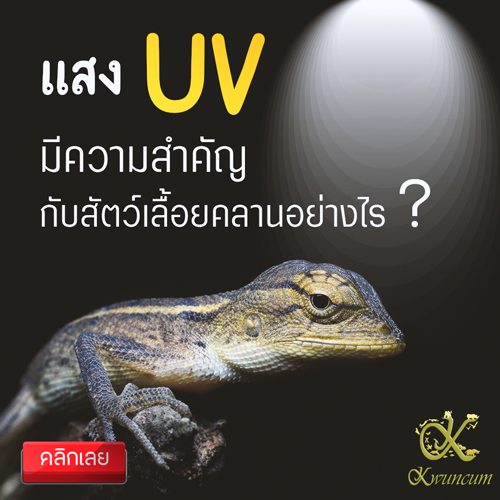
UV (Ultraviolet) Light and Reptile Husbandry
By Dr. Kaew (Asst. Prof. Dr. Somphoth Weerakul, DVM)
The reason I am writing about this topic again is due to the increasing popularity of keeping reptiles, as well as amphibians, fish, and plants that require UV light.
Nearly a decade ago, I wrote about reptile care, including the use of appropriate UV lighting. At that time, I was studying the conservation of Elongated Tortoises at Ban Kok and King Cobras at Ban Khok Sa-nga, long before the establishment of the professional breeding centers seen today.
Those studies resulted in three books: a manual on Tortoise Care and Husbandry, one on King Cobra Care and Husbandry (intended for the Tourism Authority to plan proper conservation), and a third titled Reptile Medicine for Veterinarians. The latter was written in significant detail for the Veterinary Practitioner Association and my first intensive teaching sessions. These should still be available in veterinary faculty libraries or through professional networks.
However, I want to provide a simple summary for enthusiasts regarding why UV light is necessary and how to choose the right type or brand. Enough with the introduction—let’s dive into the details.
Understanding UV Light
UV light has a wavelength between 200 nm and 400 nm, categorized into three types:
UVC (200–280 nm): Invisible to the eye. This is generally unnecessary for reptiles and is primarily used for sterilization in operating rooms or laboratories because it kills bacteria. At high intensities, it is dangerous to humans and animals.
UVB (280–320 nm): Crucial for health. While invisible to us, it triggers the synthesis of Vitamin D3, which is vital for calcium metabolism and bone formation.
Snakes: Most snakes do not strictly require UVB as they obtain Vitamin D3 from the livers of their prey. However, some species (like Pythons) benefit from it.
Tortoises and Lizards: UVB is non-negotiable. Without it, they cannot survive long-term.
Amphibians: Data is less clear, but most reports suggest it isn't strictly necessary. Regardless, remember that vitamins come from two sources: light and diet. You must provide both.
UVA (320–400 nm): Partially visible to some animals. It is important for both humans and animals as it stimulates appetite and regulates natural behaviors such as foraging, sleeping cycles, and mating.
The Danger of Poor Lighting: The Iguana Example
Sunlight is the best source of UV. If you house your pets outdoors, artificial lighting isn't necessary. However, for indoor habitats, it is critical.
Take Iguanas as an example. They are highly susceptible to Metabolic Bone Disease (MBD). If an owner provides improper lighting—either no sunlight at all or bulbs that lack UVB—the iguana will become weak within six months. They may fall from branches, and their limbs break easily. Repairing these fractures is extremely difficult because the bones become paper-thin.
Choosing the Right Bulb: Don't Be Misled
Many beginners go to markets or pet shops and get talked into buying the wrong equipment due to a lack of knowledge.
Incandescent Bulbs: Standard heat bulbs do not provide UVB. They are fine for snakes that only need a heat source to regulate body temperature (since they are ectotherms), but they won't help a tortoise.
Deceptive Labeling: Some brands label bulbs as "Reptile Incandescent Light." Do not be fooled; these are generally not "Full Spectrum" (meaning they lack the necessary balance of UVA and UVB) and are unsuitable for lizards and tortoises.
Fluorescent Bulbs: These are the most common source of UV, but not all fluorescents emit UVB. Some are designed for humans and have filters to block UV to safe levels, which aren't strong enough for a reptile’s D3 synthesis.
Installation and Maintenance Tips
Even with the right bulb, mistakes in setup can render it useless:
No Glass or Plastic Shields: If you place the bulb behind glass or plastic (even clear ones), nearly 100% of the UVB rays are filtered out. Use a wire mesh screen instead.
Distance Matters: The ideal distance from the bulb to the animal’s basking spot is approximately 12 inches (300 mm).
Bulb Expiration: Just because a bulb is still emitting visible light doesn't mean it’s working. The UVB output decays over time, often becoming ineffective long before the bulb actually "burns out."


